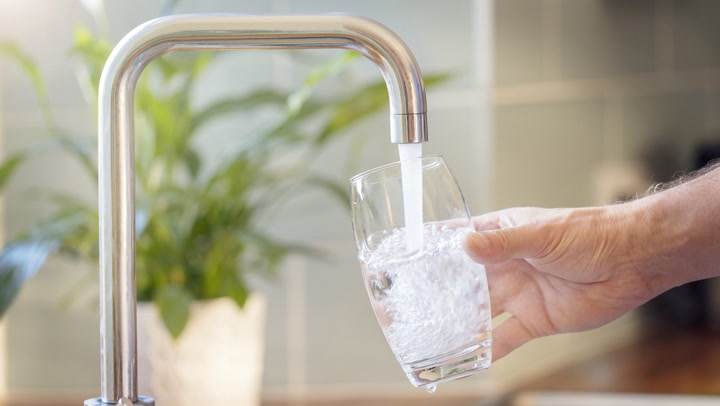
If you have recently moved into one of the sleek glass towers in Exchange Place, Newport, or Paulus Hook, you may have noticed a sensory disconnect. You are looking out at a world-class view of the Manhattan skyline, but the glass of water in your hand tastes notably different than what you grew up with—or even what you might find in a brownstone just a mile inland in Jersey City Heights.
This isn’t your imagination. The “Waterfront Profile” is a well-documented phenomenon in Jersey City. While the Jersey City Municipal Utilities Authority (JCMUA) sources high-quality water for the entire city, the journey that water takes to reach a 50-story luxury high-rise on the Hudson River is vastly different from its path to a two-story home on a hilltop. From the materials of the city infrastructure to the mechanics of high-rise living, several factors converge to change the flavor of the water at the water’s edge.
The Source vs. The Journey
Jersey City water primarily comes from the Boonton Reservoir and the Split Rock Reservoir. It is treated at a state-of-the-art facility before being pumped through the city. At the treatment plant, the water is crisp and neutral. However, water is a “universal solvent.” As it travels through miles of urban water systems, it interacts with the pipes and storage systems it encounters.
The Waterfront is essentially the “end of the line” for many of Jersey City’s primary water mains. In the world of hydraulics, the further water travels from the source, the more “residence time” it has in the pipes. This increased time allows for more interaction between the water and the pipe walls, which is the first step in creating that distinct Waterfront taste.
New Pipes vs. Old Iron
One of the ironies of living in a brand-new building on the Waterfront is that your water may taste more like the city’s plumbing than water in an older neighborhood. Much of the Waterfront sits on land that was formerly industrial or rail yards. To support the massive new developments, the city had to install miles of new, high-capacity mains.
While these modern pipes are cleaner than the 100-year-old unlined cast iron found in the Heights, they are often made of cement-lined ductile iron. In the first few years of a new pipe’s life, the cement lining can slightly alter the alkalinity (pH) of the water as it passes through. This subtle shift in pH is often perceived by residents as a “flat” or slightly “sweet” mineral taste, a common topic in our faq.
The Chlorine Gradient
To keep water safe from bacteria over long distances, the JCMUA maintains a chlorine residual. Because the Waterfront is home to such high-density housing, the water turnover is immense. During peak hours, water is rushing into the Waterfront at high velocities to keep up with thousands of morning showers.
This high flow rate often brings “fresher” chlorine residuals into the area. Furthermore, the high-pressure systems required to move water into 40-story towers can cause chlorine gas to “aerate” more aggressively when it hits your glass. This results in a stronger “pool-like” scent that many residents mistake for a water quality issues, when it is actually a sign that the disinfectant is active and doing its job.
Vertical Storage: The Suction Tank Factor
The most significant factor in the Waterfront taste profile isn’t the city’s pipes—it is your building’s internal buildings plumbing. New Jersey’s standard street pressure isn’t strong enough to push water to the top of a skyscraper. Every luxury tower on the Waterfront uses a “suction tank” and booster pump system.
Water enters the building from the street and is held in a massive basement storage tank. From there, pumps send it to the upper floors. This holding period in the suction tank is a “stagnation event.” Even if the tank is made of food-grade stainless steel or reinforced plastic, the water sits and “breathes.” This can lead to:
- Temperature Creep: Basement tanks are often located near mechanical rooms or boiler systems. As the water sits, it warms up. Warm water releases more odors and has a “heavier” mouthfeel than the cold, crisp water found in direct-pressure homes.
- Loss of Oxygen: As water sits in a tank, it can become “flat” as the dissolved oxygen escapes. This is why Waterfront water often tastes better after it has been run through a simple aerated faucet or a Brita pitcher.
The “New Building” Metallic Tang
In many Waterfront developments, the internal risers are made of copper. While copper is an excellent material for plumbing, new copper pipes undergo a “passivation” period. For the first six to twelve months after a building opens, the water may have a faint metallic or “penny-like” tang as a protective layer of oxidation forms inside the copper lines.
If you are one of the first tenants in a new Waterfront tower, you are essentially drinking water from a brand-new copper system. We often see spikes in reports of metallic tastes on our blog whenever a major new development like Haus25 or Urby opens a new phase.
Tuberculation and Construction Surges
While the Waterfront has many new pipes, it is still connected to the older “trunk” lines that feed the rest of Jersey City. These older pipes are often heavily “tuberculated”—filled with mounds of iron oxide (rust).
When a new construction project nearby engages a high-capacity fire hydrant or performs a “tap” into the main, it causes a surge in water velocity. This “scours” the rust off the old inland pipes, and that sediment is carried downstream to the Waterfront. This is why Waterfront residents might see sudden, temporary “brown water” events even if their own building’s pipes are pristine.
How to Improve Your Waterfront Water
If the specific taste of the Jersey City Waterfront is bothersome, you don’t necessarily need an expensive filtration system. Most of the taste issues are aesthetic rather than safety-related.
- Carbon Filtration: A simple charcoal filter (pitcher or faucet-mount) is highly effective at removing the chlorine scent and the “flat” taste caused by suction tank stagnation.
- The Chill Factor: Keeping a glass carafe of water in the refrigerator allows the chlorine to gas off naturally and restores the crispness that temperature creep takes away.
- Aeration: If the water tastes flat, simply pouring it between two glasses several times can re-oxygenate it, significantly improving the “brightness” of the flavor.
Conclusion: A Modern Palate for a Modern Neighborhood
The water on the Jersey City Waterfront isn’t “bad”—it is simply “urban.” It is water that has travelled a long distance, been stored in high-tech tanks, and moved by powerful pumps. It carries the signature of a neighborhood that is built on the cutting edge of modern density.
Understanding that your water’s taste is a byproduct of the engineering required to live 400 feet in the air can change your perspective on that morning glass of tap. While the Waterfront profile may be different from the Heights or Downtown, it remains part of a system that is rigorously monitored and maintained.
If you have noticed a sudden, persistent change in your water’s taste—especially if it is accompanied by a change in color or pressure—it may indicate a localized mechanical issue in your building’s tank system. Please reach out via our contact page so we can help you determine if your “Waterfront taste” is normal or a sign of a deeper infrastructure problem.