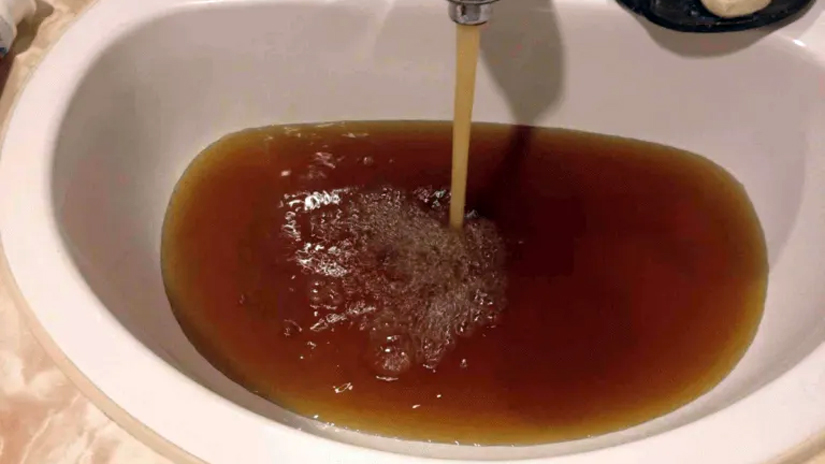
It is a scenario familiar to many New Yorkers: the water pressure in your apartment drops to a mere trickle for an hour—perhaps due to a nearby fire hydrant being used or a temporary utility repair—and then, suddenly, the pipes groan, a burst of air hisses from the faucet, and the water returns in a rushing “rebound.” However, instead of the clear, crisp water you expected, the stream is a dark, murky brown or a rusty orange.
While it is tempting to think that “dirty” water has somehow entered the system from the outside, the reality is usually much more local. The brown water seen after a pressure rebound is a classic physical reaction within our urban water systems. It is the result of a sudden change in velocity and direction acting upon decades of accumulated minerals within the pipes. Understanding this “scouring” effect is essential for protecting your buildings plumbing and knowing when a simple flush is enough to fix the problem.
The Anatomy of an Aging Pipe: Tuberculation
To understand why a pressure rebound turns water brown, we first have to look at the interior of New York City’s city infrastructure. Much of the water main network beneath Manhattan, Brooklyn, and the Bronx consists of unlined cast-iron pipes, some of which have been in continuous service for over a century.
Over decades, these pipes undergo a process called tuberculation. As the iron in the pipe reacts with the oxygen in the water, it forms jagged, coral-like mounds of iron oxide (rust) and manganese. In a stable environment, these mounds are relatively firm. Under normal, steady-state conditions, the water glides over them smoothly, and the “crust” remains attached to the pipe wall.
The Mechanics of the “Scour”
When a pressure drop occurs—whether from a water main break, a heavy draw by a nearby hospital, or the opening of a fire hydrant—the water in the pipe slows down or stops. In some cases, it may even briefly reverse direction. This change in flow allows some of the finer sediment to settle at the bottom of the main.
The real trouble begins during the pressure rebound. When the cause of the drop is removed and the full force of the city’s gravity-fed system or a building’s booster pumps kicks back in, the water rushes into the pipes at a much higher velocity than normal to fill the “void” created by the pressure loss.
This sudden surge of high-velocity water acts like a mechanical abrasive. It “scours” the interior of the pipe, ripping the brittle, top layer of iron oxide mounds off the walls and into suspension. This results in the concentrated “slug” of brown water that arrives at your tap. This is one of the most frequent water quality issues reported to the NYC DEP, especially in neighborhoods with older infrastructure.
Water Hammer and Pipe Shock
The “rebound” doesn’t just scour the street mains; it shocks your building’s internal plumbing as well. When water pressure returns suddenly, it often carries pockets of trapped air. As this air-and-water mixture hits a bend in the pipe or a closed faucet, it creates a “water hammer”—a physical shockwave that travels back through the plumbing.
In a pre-war building with original galvanized steel or copper risers, this shockwave can shake the pipes violently. This vibration “knocks” loose the sediment that has been sitting inside your building’s own vertical lines for years. This is why you might see brown water even if the city main in the street is relatively clean; the “rebound” has effectively shaken your building’s own internal “clogged arteries.”
The Hidden Risks to Your Home
While the Department of Health generally considers this iron-rich water a “secondary” aesthetic concern rather than a direct health threat, it is chemically and mechanically hard on your home assets:
- The Hot Water Accumulation: If you run your hot water during a pressure rebound, you are pulling that concentrated “slug” of rust directly into your hot water heater or the building’s central boiler. This sediment settles at the bottom of the tank, where it acts as an insulator, making the heater work harder and eventually causing the tank to “rumble” or fail prematurely.
- Fixture “Blinding”: Modern, high-efficiency faucets utilize very fine mesh aerators. The gritty particles released during a pressure rebound are exactly the right size to “blind” or clog these screens. If your pressure remains low long after the water has cleared, a clogged aerator is usually the culprit. We explain how to clean these in our faq.
- Staining: Concentrated iron oxide is a powerful dye. Running a load of laundry during a pressure rebound is a guaranteed way to permanently stain whites and linens.
The “Post-Rebound” Protocol
If your block has just experienced a pressure drop and subsequent rebound, do not immediately resume normal water use. Follow these steps to clear the system safely:
- The Cold Flush: Go to the cold water tap of your bathtub. Because a bathtub has the highest flow rate and usually lacks a restrictive aerator, it is the best place to purge the system. Run the cold water at full blast for 10 to 15 minutes.
- Avoid the Hot Tap: Do not turn on the hot water until you have verified that the cold water is crystal clear. This prevents the “scoured” sediment from entering your water heater.
- Check Your Filter: If you have an under-sink or whole-house filter, the sediment from a pressure rebound can “load” the filter instantly, rendering it useless. Check the color of your filter cartridge after an event; if it is dark brown, it needs to be replaced.
- Monitor the Neighborhood: We track localized “pressure surge” events and infrastructure failures in our blog. If your water doesn’t clear after a 20-minute flush, it may indicate a larger problem with the street main that requires city intervention.
Conclusion: A System Under Tension
Brown water after a pressure rebound is a physical reminder that our urban water systems are under constant tension. The interaction between 19th-century iron and 21st-century demand means that any interruption in flow will inevitably disturb the status quo inside the pipes.
By understanding the “scouring” effect, you can protect your appliances and ensure that the “champagne of tap water” returns to its clear state as quickly as possible. If you find that your water pressure has remained low or the discoloration persists despite flushing, please reach out via our contact page. We help residents determine if their issue is a building-specific mechanical failure or a sign of a broader infrastructure problem on their Manhattan or Brooklyn block.